Echo From Beyond — Overview — Bastiaan Woudt | Studio Woudt
Overview · Bastiaan Woudt
Echo From Beyond
Overview
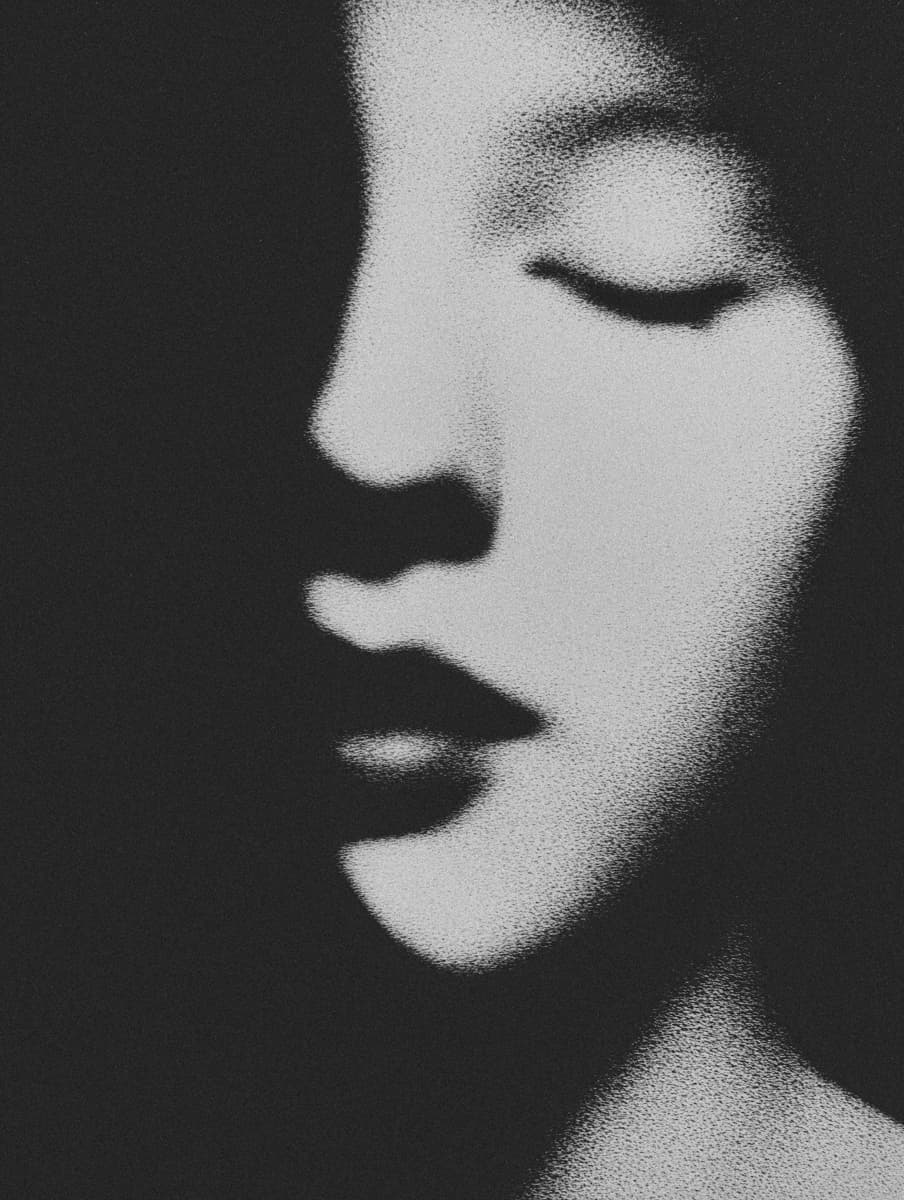
Echo from Beyond is an ongoing body of work in which Bastiaan Woudt merges his photographic archive with artificial intelligence. Not documentation of the world outside, but an exploration of the world within.
The series
A selection from the series
Pricing
All works are produced in unique one-of-one editions, printed once only. Prices are per signed, numbered print. Print-only is the bare print; framed includes museum-grade framing, passe-partout, UV glass and the mounted certificate of authenticity. All prices include 9% Dutch tax.
Format
Print only
Framed, incl. 9% Dutch tax
Postcard
€ 1.250
€ 1.700
A5
€ 1.750
€ 2.250
A4
€ 2.250
€ 2.800
A3
€ 3.250
€ 3.800
A2
€ 3.900
€ 4.800
60 x 80 cm
€ 6.500
€ 7.500
90 x 120 cm
€ 6.500
€ 7.500
150 x 200 cm
€ 12.500
Editions & Sizes
All works are produced in unique one-of-one editions, printed once only. Each work is offered in a range of formats; see the pricing table above for exact dimensions and availability.
About the series
Echo from Beyond is an ongoing body of work in which Bastiaan Woudt merges his photographic archive with artificial intelligence. Not as documentation of the world outside, but as an exploration of the world within. The project began in 2023 as a creative sketchbook, a space parallel to his established photographic practice where the rules are different and the images do not need to exist before they are made.
The work draws on more than thirteen years of photographs, thousands of images accumulated across projects in Morocco, Uganda, Nepal, Zambia, Japan and the studio. This archive serves as raw material: texture, form, tone, memory. Through AI, Woudt feeds these fragments back into a process that reshapes them into something new. Each image is the result of a sustained dialogue between what was photographed and what was imagined.
Echo from Beyond exists alongside Woudt's photographic work, not as a replacement but as an extension. Where photography requires something in front of the lens, this project allows him to start from nothing, almost as a painter approaches a blank canvas. It is mixed media in the truest sense: part photography, part technology, part intuition.
The Journey
The origin of the project is not a place. It is a shift in thinking.
For years, Woudt carried ideas that could not be photographed. Visions that emerged from dreams, from psychedelic experiences, from music, film, and the accumulation of daily observation. In his established practice, these ideas would be noted and stored, waiting for the right shoot, the right model, the right location. Many never materialised. The gap between thought and image remained.
When AI tools became available to him, Woudt recognised something specific: the ability to translate an internal vision directly into a visual form. Not by generating images from scratch, but by combining the language of AI with his own photographic archive. The thousands of images he had made over thirteen years became the foundation. The ideas he had carried became the direction.
The first works emerged in 2023. Woudt describes the process as layered: an idea or experience triggers a direction, AI generates interpretations, and then his archive is woven in. The result is neither purely photographic nor purely generated. It exists in between, carrying the weight of real images and the freedom of imagination.
Collecting
What you can expect when you acquire a work from Studio Woudt.
Editions
Strictly limited editions, numbered and signed by the artist. Once closed, an edition is never reprinted.
Printing
Archival pigment prints on museum-quality paper, produced with one specialised fine art printing studio. Every print is individually inspected.
Framing
Museum-grade wooden frames with UV-protective glass, acid-free mounting and a passe-partout sized to the work.
Worldwide shipping
Fully insured shipping. Within Europe delivered and installed in person; outside Europe flown in custom fine-art crates.
Studio Woudt · Hazenkoog 9, 1822 BS Alkmaar · janneke@bastiaanwoudt.com
€ 15.000
This was not an overnight experiment. Each image in the series requires hours of iteration. Woudt guides the process through each step, adjusting, discarding, refining. The unpredictability of AI is part of the method, but the final decision is always his. The machine proposes. The artist decides.
The project's name reflects its nature. "Echo" refers to the photographic archive, images that echo from the past. "Beyond" refers to what lies ahead, the territory that could not be reached with a camera alone.
Themes & Intent
Echo from Beyond investigates the space between photography and imagination. Each image sits on the border of recognition and doubt. Is it a photograph? Is it assembled? Is it drawn? Woudt is less interested in answering these questions than in keeping them open.
The work shares the visual DNA of his photographic practice: monochrome, high contrast, minimal, with a strong sense of form and texture. The chiaroscuro that runs through all his work, rooted in Rembrandt and refined through years of studio practice, is present here too. But the subjects are different. Figures emerge from landscapes that do not exist. Architecture bends. Nature takes forms that hover between the organic and the impossible.
Psychedelic experiences play a direct role. Woudt has written openly about the influence of these experiences on his creative process, describing them as moments that dissolve the boundary between internal and external perception. In Echo from Beyond, these states find visual expression for the first time. The work does not illustrate psychedelic experience. It translates the logic of those states, the layering, the fluidity, the sense that familiar forms contain hidden structures, into still images.
The choice to work in black and white is deliberate. Colour would anchor the images in a specific reality. Without it, the viewer is drawn into form, texture, and atmosphere. The absence of colour creates the same effect it does in Woudt's photography: it removes the literal and invites projection.
Viewers respond differently to these works than to his photographs. They spend more time looking. They ask more questions. Some are drawn to the images that could pass for photographs. Others prefer the ones that clearly could not be. This uncertainty, this productive discomfort, is part of what the project explores. As Woudt has noted: "Perhaps the real question is not whether AI can create art, but how it alters our perception of ourselves as creators."
Working with AI
The process begins with an internal image. A thought, a memory, a residue from a dream or experience. In his photographic practice, Woudt would need a person, a landscape, or an object in front of his camera. Here, he starts with nothing visible. The first step is always language: describing to AI what he sees in his mind.
From there, iterations begin. AI generates possibilities. Woudt selects, adjusts, rejects, and refines. His photographic archive, comprising thousands of images taken over more than thirteen years, is then layered in. The textures, tonal qualities, and formal signatures of his existing work become embedded in the new image. The result carries the DNA of real photographs without being one.
This process can take many hours for a single work. It demands the same attention and editorial rigour as his photography, perhaps more. The freedom of working without physical constraints brings its own challenges. Without the limitations of light, space, and time, the artist must impose his own discipline. Woudt describes the paradox: "This shift has given me a freedom that I had never experienced before. As a photographer, I always needed something in front of me. With AI, I can create from nothing, almost as a painter does with a blank canvas. Yet this freedom raises a question: if my hand becomes less visible, does the image still belong to me?"
For Woudt, the answer is yes. AI is the instrument, not the author. "AI is not the artist," he has written. "It is merely the board on which I continue to play. The stories and choices are still mine, but the board enables me to ask new questions."
The Works
Every image in Echo from Beyond is unique. There are no editions. Each work exists as a single piece, numbered sequentially (Echo 9, Echo 10, Echo 25, and so on). This distinguishes the project from Woudt's photographic editions, which are typically produced in limited runs.
The prints are made using Piezography Pro inks on Awagami Bizan Medium White, a handmade Japanese paper. The deliberate contrast between cutting-edge digital creation and centuries-old paper is central to the work's identity. The delicacy and texture of the Japanese paper adds a physical quality that resists the assumed coldness of AI-generated imagery.
Printing is handled by Studio Luc Brefeld. Formats range from postcard size to large-scale works of 150 x 200 cm, with available sizes including A5, A4, A3, A2, 60 x 80 cm, and 150 x 200 cm.
Two book publications are in development through 1605 Publishers. The first, Echo from Beyond, will present the core body of work. The second, Yaxché, takes the project into a specific imagined landscape: a green cathedral of vines and mist, rooted in childhood imagination and Mayan cosmology. In Mayan tradition, the Yaxché, the sacred ceiba tree, connects the heavens, the earth, and the underworld. For Woudt, it became the symbol of an internal world he has carried since childhood, a place both ancient and invented, now given visual form through AI and his photographic archive.
Exhibitions & Press
Echo from Beyond debuted in September 2024 at a solo exhibition at Jaeger Art in Berlin, where three of four works sold on opening night. The exhibition ran until November 2024. A selection from the project was subsequently shown at The Phair art fair in Turin (May 2025) with Jaeger Art Berlin, marking the first time Woudt's AI-driven works and traditional photography were presented side by side.
Further exhibitions have included In the Pink Fine Art Photo Gallery in the Algarve, Portugal (2025), where Echo from Beyond works were shown alongside selections from Champions and the studio work, and Alzueta Gallery in Barcelona (2026).
The project has been featured in interviews and articles in Algarve Magazine, Professional Photo Magazine, Communication Arts, and on Woudt's Substack newsletter Studio Notes. Works from the series are available through Jaeger Art Berlin, Jackson Fine Art (Atlanta), Fahey/Klein Gallery (Los Angeles), Bildhalle (Zurich/Amsterdam), and directly through Studio Woudt in Alkmaar.
Reflection
Woudt sees Echo from Beyond as a necessary expansion of his practice. Not a departure from photography, but an acknowledgment that some images cannot be made with a camera. The project occupies a space between his photographic past and an uncharted future, the same tension that has driven his work from the beginning.
What began as a sketchbook has become a sustained body of work that challenges both the artist and his audience. Viewers spend more time with these images. They ask different questions. The familiar visual language of Woudt's photography is present, but the ground has shifted. Something is recognisable. Something is not. It is precisely this uncertainty that gives the work its charge.
The project is ongoing. New works are released periodically, each one unique. The archive grows. The questions multiply. For Woudt, this is the point. "I am certain," he has written, "that the game has only just begun."